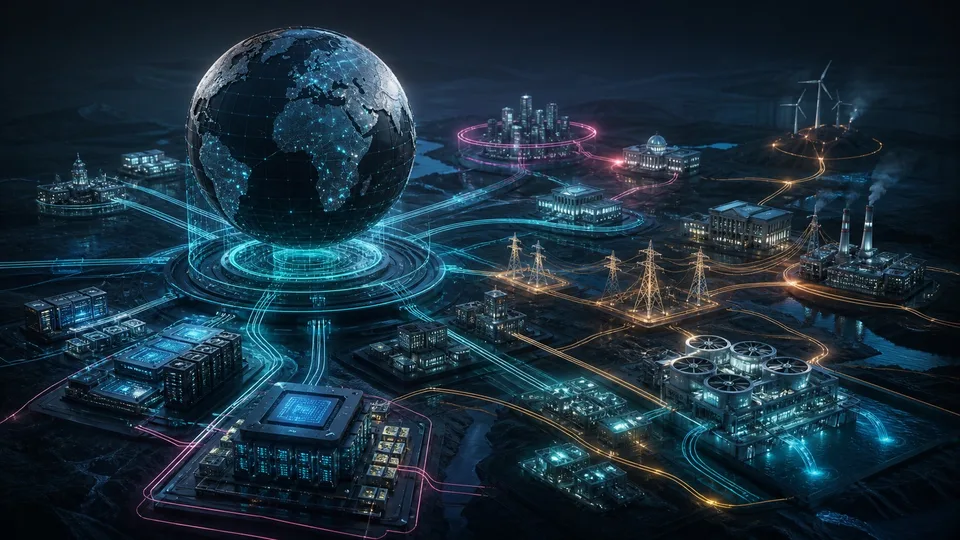
The AI race is usually presented as a contest between models: more intelligence, more speed, more users, more capital.
But every model runs on a physical system.
It needs chips, servers, data centers, cooling, electricity, transmission, construction, financing, workers, and public approval. The cloud may look weightless from a browser, but it is becoming one of the largest industrial systems on Earth.
That is why I rebuilt Omikina.
What began as a detailed map of U.S. AI infrastructure is now a global intelligence platform for following the companies, countries, physical systems, and current evidence shaping the AI race.
The AI race is bigger than the model leaderboard
I started Omikina because most coverage stops at product releases, benchmark scores, and funding announcements. Those signals matter, but they are only the visible edge of a larger machine.
Every prompt eventually reaches a machine inside a real building. That building needs power, cooling, land, equipment, and a connection to the grid. The company behind it needs capital, construction capacity, workers, government approvals, and some level of public trust.
The newest version of Omikina makes those dependencies easier to follow without losing the evidence behind them.
The goal is not to make the system look simple. The goal is to make the complexity legible.
From a U.S. atlas to a global intelligence layer
The original project focused on the physical buildout beneath American AI. That detailed U.S. infrastructure atlas is still part of the platform.
It maps companies, data-center projects, grid operators, power systems, nuclear fuel, construction, policy, government actions, and communities. Select an entity and Omikina can show what it needs, what depends on it, which facilities are connected to it, and what evidence supports the relationship.
The new global map adds another level.
You can now move between country profiles, companies, and infrastructure records without leaving the map. The initial country layer covers the United States, China, the United Kingdom, France, the United Arab Emirates, and India. The company directory follows frontier laboratories, cloud platforms, and compute suppliers across those markets.
The coverage is deliberately honest about its limits. A country can be labeled detailed or foundational. A claim can be sourced, company-reported, inferred, or illustrative. A map should never look more certain than the information behind it.
Hourly news now lands inside a system
The rebuilt evidence monitor checks a broad directory of technology, infrastructure, energy, policy, and community sources every hour.
Each article is tagged by the part of the system it touches:
- AI and compute
- Data centers
- Grid infrastructure
- Power
- Nuclear and fuel
- Capital
- Government
- Communities
The entire article card is clickable. Topic tags carry matching icons. When a publisher does not provide a useful image, Omikina uses restrained fallback artwork instead of a broken or misleading thumbnail.
More important, the feed does not confuse a headline with a fact.
Hourly reporting is treated as a discovery signal. It can point toward a company, country, project, or system constraint, but it does not silently rewrite a verified relationship in the atlas. That review boundary is essential in a field filled with proposed campuses, projected power needs, memoranda, ambitious timelines, and claims that may change before construction begins.
Company intelligence is reviewed, not automated into noise
The first editorial edition adds current, source-linked updates for eight tracked U.S. companies and six tracked Chinese companies.
The U.S. group includes OpenAI, Anthropic, Meta, xAI, Microsoft, Amazon, NVIDIA, and Oracle. The China group includes Alibaba, DeepSeek, Baidu, Tencent, ByteDance, and Huawei.
Each update appears in the main news feed and on the matching company profile. The articles include key points, topic tags, direct source links, and an Omikina assessment explaining why the development matters to the wider AI system.
I made one important editorial choice: the AI writer does not publish something every hour.
The news monitor can keep checking for change. An editorial article is created only when there is a reason to write one. That keeps Omikina responsive to breaking news without turning it into an endless stream of thin summaries.
Automation should help find the signal. It should not remove judgment from publication.
What I want Omikina to become
Omikina is not meant to predict a winner or turn every announcement into certainty.
It is meant to help people see the machine:
- Who is building?
- What do they depend on?
- Where are the physical constraints?
- Which claims have real support?
- Which public decisions could change a project?
- How does a local development fit into the global race?
The next step is deeper country coverage, more reviewed infrastructure records, and better ways to compare how companies and governments are building AI capacity.
My invitation is simple: open Omikina, move the globe, choose a company, follow a dependency, read a source, and tell me what the platform should investigate next.
Because AI is becoming physical, financial, and political infrastructure.
If we only watch the models, we miss the machine.
Disclosure: I used AI assistance to research, structure, and edit this article. The platform descriptions and links were reviewed against the live Omikina release before publication.