Interactive Experiences
DIODE
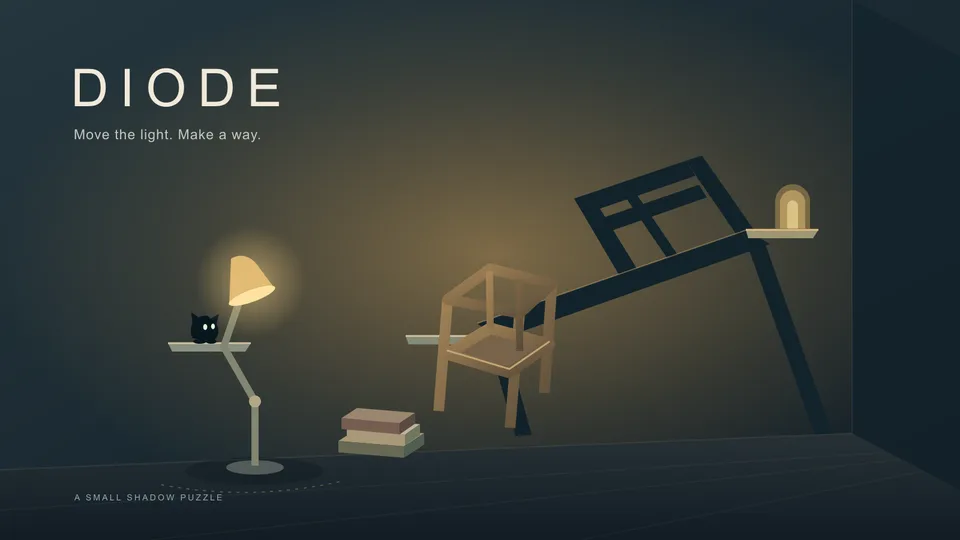
Move the light. Make a way.
- Ownership
- Game Design, Creative Direction & Development
- Current status
- Playable browser game.
- Designed for
- Curious players looking for a quiet, short puzzle they can play directly in a browser.
- Case study
- 2 min read
Executive summary
The decision brief
Ownership, the central tradeoff, collaboration boundaries, and what the current record supports.
-
01 Role
Game Design, Creative Direction & Development
-
02 Key decision / tradeoff
Use the same projected geometry for visible shadows and walkable surfaces, so each discovery follows the room's own rules.
-
03 Collaboration boundary
An independent creative project developed with AI-assisted programming.
-
04 Current evidence
The playable game is the project: move the lamp, connect shadow surfaces, and guide the creature toward its refuge.
Documented period · 2026
Scope & evidence
Outputs, evidence, and limits
Outputs describe what was made or delivered. The evidence boundary below states what has—and has not—been validated.
Responsibilities
- Interaction and puzzle design
- Shadow projection and traversal
- Procedural art direction
- Browser implementation
Documented outputs & delivery record
- A complete, self-contained browser game with 21 miniature rooms.
- A moving lamp transforms fixed furniture into temporary shadow paths.
- Permanent safe perches give the player room to pause and experiment.
Full story
How the work took shape
An ordinary object, another possibility
DIODE begins with a simple invitation: move a lamp and see an ordinary chair become a bridge. The room stays still. The light changes what is possible.
A tiny, ink-dark creature lives on the wall’s ledges and the upper edges of projected shadows. Choose a safe perch, then find a lamp arrangement that makes a continuous path. When the connection is ready, the creature follows it.
Twenty-one rooms of light
The first room introduces the chair and books. Twenty further rooms explore climbs, reversals, overlapping shadows and changing lamp distance. Each room has its own layout, a safe checkpoint and a way onward. A missing bridge asks for another arrangement; a vanished support returns the creature gently to its last safe perch.
The result is a puzzle about observation and changing perspective, without a timer, combat, or a jump button.
Light as an interaction
The furniture’s projected shapes define both the image and the traversable boundaries. Moving the lamp changes those shapes continuously, keeping the visible bridge and the creature’s route in agreement.
Warm amber light, crisp silhouettes, small creature gestures, and restrained sound make the room feel quiet and tactile. The visual treatment serves the puzzle: a path should be inviting, and its edges should be readable.
Play DIODE in your browser. Drag the lamp and choose a place to go; keyboard controls and sound preferences are available inside the game.
A relevant next step
Have an interaction worth exploring?
Let's turn a clear creative premise into a small, expressive experience people can actually play.