Interactive Products
Agent & CMS Integration
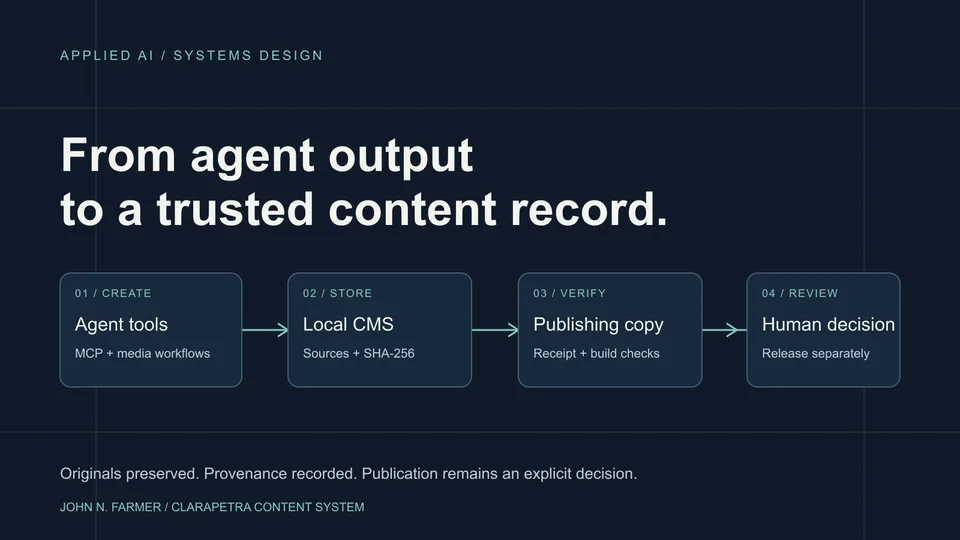
Connecting AI tools, original media, and publishing workflows through a local repository with verifiable provenance.
- Ownership
- Product Strategy, Workflow Architecture & Implementation
- Current status
- Working local CMS and MCP integration used by the Clarapetra website workflow.
- Designed for
- Creative operators and product teams coordinating original content, AI tools, and website publishing.
- Case study
- 3 min read
Executive summary
The decision brief
Ownership, the central tradeoff, collaboration boundaries, and what the current record supports.
-
01 Role
Product Strategy, Workflow Architecture & Implementation
-
02 Key decision / tradeoff
Make the content repository the source of record. Give agents explicit storage and verification tools while retaining human review and separate publishing authority.
-
03 Collaboration boundary
I defined the workflow, content boundaries, and review requirements, and directed AI-assisted implementation and testing. Higgsfield supports media generation; local editing and CMS ingestion retain the source trail.
-
04 Current evidence
The MCP interface and repository health were inspected on September 27, 2026. Source inspection confirmed ingestion, checksum verification, writer locks, receipts, and website sync/check gates.
Documented period · 2026–Present
Scope & evidence
Outputs, evidence, and limits
Outputs describe what was made or delivered. The evidence boundary below states what has—and has not—been validated.
Responsibilities
- Content model and workflow design
- MCP tool integration
- Source preservation and provenance
- Website synchronization and build checks
- AI-assisted implementation and verification
- Creative production workflow integration
Documented outputs & delivery record
- Implemented six MCP tools for repository health, search, retrieval, file ingestion, exact-text saving, and verification.
- Connected agent outputs to source-preserving storage with SHA-256 checks and durable provenance receipts.
- Integrated CMS coverage checks into the website build and deployment workflow.
- Established separate stored, reviewed, published, and live-verified states across creative production.
Full story
How the work took shape
The problem: creative output scattered across tools
Clarapetra combines music, artwork, video, web experiences, games, and release copy. AI-assisted work adds another coordination problem: an output may originate in a generation service, a download folder, an agent session, or a website checkout. A useful file is easy to lose; its source, exact text, or review status is even easier to lose.
I designed a local content repository to make that handoff explicit. The website consumes publishing copies. Original content and its history belong in the repository.
My contribution
I defined the content model, ingestion rules, agent workflow, and publishing boundaries, then directed their implementation with AI assistance. The work connects product design with practical systems decisions: what an agent may write, how a revision is identified, how concurrent writers coordinate, and how a website proves that its content is accounted for.
This is solutions architecture at the workflow level: connecting existing tools and defining the contracts between them. It does not involve training a foundation model.
An interface agents can use
The local MCP server exposes six focused operations: check health, search, retrieve, ingest a file, save exact text, and verify stored content. An agent can find an existing original before generating a revision, store its output with source references, and check the resulting managed file.
File ingestion copies the source rather than moving or replacing it. Text saving preserves the supplied UTF-8 content. A SHA-256 digest identifies the stored bytes; an ingestion receipt records the source and generation provenance. Verified duplicates can reuse a managed item while retaining a new receipt for the handoff.
Reliability belongs in the workflow
The browser interface, MCP server, and website sync process share a writer lock to protect catalog updates. Website synchronization has its own lock to coordinate scans and receipt updates. These are concrete responses to several tools trying to write at once.
The website bridge records which CMS items correspond to its publishing copies. Build and deployment checks verify coverage and checksums. A changed file needs a current receipt; a previous successful import is not enough to prove that today’s publishing copy matches.
Higgsfield and media production
Higgsfield is part of my creative production workflow for generated imagery and video. Generation is followed by local editing when needed, including FFmpeg processing, and ingestion of the resulting files with their source trail. Model and job details are retained when they are available; unknown provenance stays unknown.
The integration supports an operating process across tools. It is not a claim that Higgsfield is embedded in every product or that the CMS automatically publishes media.
Human review remains a separate step
Stored content starts as unreviewed. A receipt establishes that a file exists and matches its recorded bytes; it does not establish artistic approval, rights clearance, or publication. Those decisions remain separate from ingestion, as does verification that a public release is actually live.
The same principle appears in my reviewed publishing work for OMIKINA EDIT and my account of using specialist agents to develop MARGIN: agents contribute bounded work, while I reconcile decisions, inspect the result, and own delivery.
What is working, and what remains to measure
The CMS and MCP interface operate locally and support the Clarapetra website’s content workflow. This case study documents implementation and verification evidence. It does not imply a hosted CMS service, external customers, or measured improvements in production speed.
The next useful evaluation is operational: measure how often content can be traced back to an original, how concurrent writes recover, and how reliably a failed coverage check prevents an incomplete release.
From the archive
Connected work
Projects, releases, research, and field notes that add detail to this case study.
Designing MARGIN: Why the Next Safer Step Matters More Than a Streak
How a specialist agent team helped me design MARGIN: a no-account, trauma-informed support prototype built around agency, privacy, human connection, and one manageable next decision.
Read field noteMATRIMONIA: Building an AI-Directed Album Release System
A workflow case study on turning an album release into an interactive creative system using music production, AI-assisted art direction, Codex, Firebase, and human creative direction.
Read field noteA relevant next step
Hiring for applied AI or workflow integration?
I connect product requirements, tool interfaces, data provenance, and human review to make AI workflows usable and inspectable.