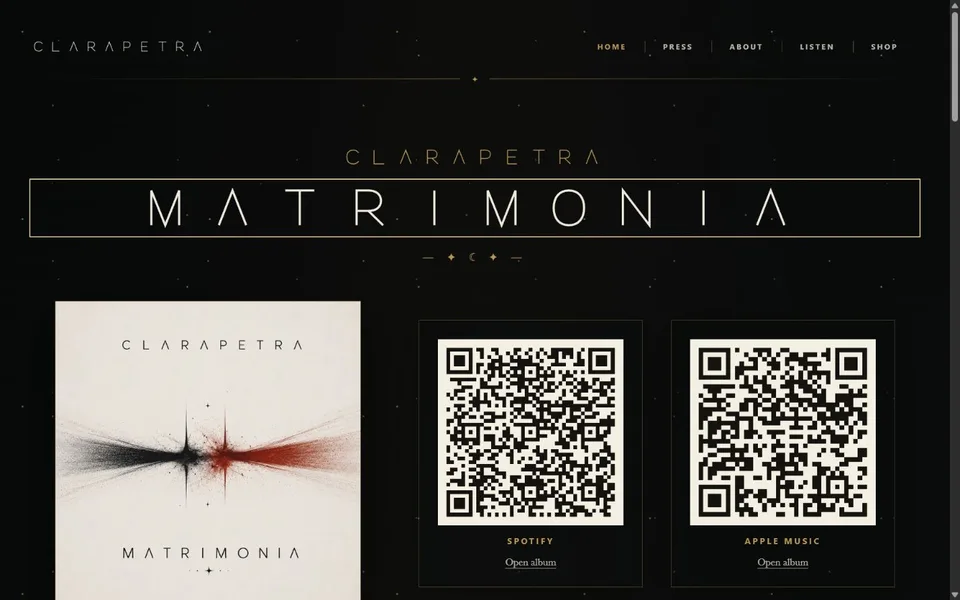
MATRIMONIA began as an album release. It became a release architecture.
The work expanded outward from the music into a visual world, an interactive invitation, narrative artifacts, social and video assets, Spotify Canvas concepts, deployment infrastructure, and a testing process that had to hold the whole thing together. Instead of treating each deliverable as a separate campaign item, I began treating them as parts of one system. A motif established in the album artwork could become an interaction on the website, a vertical motion study, a piece of release copy, or a rule for how the experience should feel on a phone.
That shift changed the central question. I was no longer asking, “How do I promote this record?” I was asking, “How do I build a world around this record without losing the emotional center of the music?”
The creative premise
The world of MATRIMONIA is a toxic ceremonial romance: beautiful, formal, threatening, and already in motion before the listener arrives. Clarapetra appears as a raven-bride with an Egyptian ceremonial presence—not a mascot placed on top of the release, but the figure through whom its themes become visible.
Black wings, moonlight, forest mist, fireflies, sealed paper, and wedding language formed the visual grammar. The ceremony could suggest devotion, entrapment, performance, or intervention. The idea of an objector mattered because it introduced a choice: participate, interrupt, or stand at the edge and watch something dangerous become official.
“The ceremony has begun” became more than a line of copy. It was a structural instruction. The release should feel as if the audience has entered an event already underway.
That premise also led me away from the earlier tarot-style call-to-action system used for ARRIVAL. MATRIMONIA needed a different object and a different social contract. The invitation replaced the card. An invitation carries a location, a ritual, an expectation, and the possibility of refusing—all of which belonged to this album’s world.
The music production challenge
The album-wide sonic goal was not simply “make it louder.” This was a mastering and release-quality problem: preserve intimacy, air, and vocal clarity while giving the record enough perceived loudness and low-end authority to sit confidently beside contemporary releases.
“Zero One” became the benchmark. It held the balance I wanted across the rest of the album: transparent enough to let the vocal breathe, but strong enough to feel finished. The challenge was to bring the other tracks into that family without flattening their individual dynamics or treating a meter reading as the artistic target.
Several priorities had to coexist:
- Preserve the openness and detail of the transparent masters.
- Increase impact without crushing transients or pushing the vocal into fatigue.
- Maintain enough tonal and dynamic cohesion for the album to play as one emotional arc.
- Let MATRIMONIA feel powerful without forcing it into the more aggressive loudness character of EAT THE RICH.
That last distinction was important. Different records should be allowed to exert pressure differently. MATRIMONIA needed weight, but its tension depended on space. The mastering decisions had to support the ceremony rather than turn every moment into the same wall.
The interactive release system
The website was designed as part of the album experience, not as a marketing page that happened to contain the same artwork. The core interaction became a ceremonial invitation engine: an environment with states, responses, and a sense of progression rather than a passive stack of cover art, biography, and streaming links.
Pointer movement affects the atmosphere. Procedural fireflies create motion without requiring a fixed video loop. Seals and invitation states turn navigation into a small act of participation. Staged interaction logic divides the experience into four zones so visual changes can arrive deliberately rather than as one undifferentiated effect.
Normalized coordinates were a practical foundation for that work. Interaction values needed to describe relative positions inside the experience, not assumptions about one desktop resolution. That made it possible to tune movement and zone transitions across changing aspect ratios, while also exposing where mobile needed its own containment and viewport rules.
The same visual system could also become a production source. Where possible, compositions and motion built for the interactive experience were adapted into vertical promotional clips, social imagery, Canvas concepts, and other release assets. Reuse did not mean exporting the same frame everywhere. It meant keeping the symbolic and spatial rules consistent while reframing them for each platform.
The AI-assisted visual workflow
AI played a real role in the visual development of MATRIMONIA. I used it for ideation, image generation, reference development, and rapid exploration of assets that would have taken much longer to sketch from scratch. It was especially useful for finding unexpected fragments: a garment treatment, a forest atmosphere, a ceremonial object, or a lighting direction that could unlock the next iteration.
But beautiful fragments are not continuity.
The difficult work was holding the world together. Anatomy had to survive across images. Symbols needed to appear in intentional positions. Garments, wings, facial identity, and the bride’s ceremonial character needed enough consistency to feel authored. The invitation envelope introduced its own production concerns, including UV layout, folds, seal placement, and typography that still had to work as designed material rather than generated texture.
Promotional continuity made the constraint problem even sharper. A compelling image in isolation could still be wrong for the campaign if the moon moved without reason, the clothing changed identity, the symbolism drifted, or the composition could not be adapted to a vertical crop.
This is where human art direction did the essential work: setting constraints, rejecting attractive mistakes, protecting meaning, and deciding what belonged. Prompts were part of the process, but taste, continuity, and judgment were the process that made the outputs useful.
Codex as an implementation partner
Codex became the implementation partner for the web side of the release. I used it to build and revise route structure, interaction logic, styling, Firebase and staging work, automated checks, and the long tail of debugging that appears once an experience leaves the idealized mockup.
The collaboration worked best when a creative intention could be converted into a narrow, verifiable task. “Make this more cinematic” is a useful direction between people, but weak implementation guidance. “Keep the moon and firefly layers unchanged, replace the environment asset in zone three, preserve normalized positioning, and verify the mobile viewport” gives the implementation something concrete to protect and something concrete to test.
The working loop became:
concept → prompt → implementation → visual review → correction → validation → deploy
ChatGPT helped with strategy, structure, language, and the articulation of options. Codex worked inside the codebase, where those decisions became components, styles, state logic, tests, and deployment changes. I remained responsible for direction and acceptance: comparing the result to the intended world, identifying what was technically correct but visually wrong, and deciding when an iteration was actually ready.
That division of labor was powerful, but it was not automatic. Codex needed precise prompts, explicit boundaries, verification steps, and human review. It was most effective as a collaborator on testable problems, not as a substitute for an unresolved creative decision.
The trials and tribulations
The system fought back in ordinary, instructive ways.
Foreground assets sometimes layered incorrectly against the bride sprite. A change meant to improve one environment zone could accidentally cover the figure, flatten the depth, or disturb the moon, clouds, mist, and fireflies that were supposed to remain continuous. The visual stack behaved less like a poster and more like a small stage: every layer had a role, and a local correction could alter the entire scene.
Mobile exposed a different category of problems. Viewport units, browser chrome, aspect-ratio changes, and containment rules could turn an elegant desktop composition into clipped artwork or unreachable interaction states. Normalized coordinates helped, but they did not eliminate the need to test the actual experience at real mobile dimensions.
Staging and production also had to remain distinct. Firebase emulator work, App Check and security validation, and deployment configuration were not glamorous parts of the release, but they determined whether the invitation was a real release tool or only a beautiful prototype. Even the local toolchain introduced friction: Java and JDK environment fixes became part of getting emulator validation to run reliably.
Playwright end-to-end checks and smaller smoke tests caught failures that visual enthusiasm could easily overlook. A cinematic transition is irrelevant if it blocks the primary action. A perfect atmosphere is not finished if the route fails after deployment. A sprite can look right in one captured frame and still break when a pointer crosses a zone boundary.
The persistent tension was between cinematic ambition and robustness. I wanted the experience to feel delicate, strange, and alive. I also needed it to load, respond, scale, survive staging, and deliver an audience to the release. Neither requirement could be treated as the boring one.
What worked
The strongest part of the project was the collaboration between human direction, ChatGPT-assisted strategy, and Codex implementation. Each part of that loop operated at a different resolution, and the handoffs improved when I made those differences explicit.
Strong worldbuilding also gave the technical choices a reason to exist. Pointer response was not added because interactivity looks impressive; it made the invitation feel reactive. Procedural fireflies were not generic decoration; they sustained the uneasy living atmosphere. Seals, stages, and zones belonged to the ceremony.
Normalized coordinates and staged validation made the interaction more stable across devices and iterations. Building reusable visual rules also meant the release world could produce multiple platform assets without starting over each time.
Most importantly, testing kept the release from becoming a haunted pile of beautiful bugs. The tests did not replace visual review, but they protected the working parts of the machine while the surface continued to evolve.
What I would improve next time
I would define reusable art-asset specifications earlier: dimensions, safe areas, transparency, lighting direction, anchor points, naming, and expected platform crops. Too many late decisions came from assets that were visually promising but not yet production-ready.
I would also create the visual bible sooner. Character rules, garment details, symbols, palette, camera language, typography, and environmental constants should exist before the asset count accelerates. Experimental generations and approved production assets should live in clearly separate pipelines.
The prompt and decision history deserves more structure as well. When a visual result succeeds, the useful record is not only the final prompt; it is the constraints, rejected directions, edits, references, and reason for approval.
Finally, I would plan platform outputs at the beginning rather than near the end: Spotify Canvas, TikTok, Instagram, the website, press images, and SoundCloud and Spotify metadata all impose different constraints. One master release source of truth should hold approved copy, credits, AI-use notes, links, metadata, and visual direction so that every surface is derived from the same decisions.
A blueprint for future releases
MATRIMONIA became a blueprint for how I want to approach independent releases: not “finish an album and then promote it,” but build a living system around the music. The record, interface, images, motion, language, metadata, tests, and release operations can all participate in the same authored world.
The future of independent music is not just distribution. It is worldbuilding, workflow, authorship, and systems that let one person direct an entire strange machine.