AI Intelligence Platform
OMIKINA GOV
A U.S. public-records publication that makes its sources, AI editorial identities, and review limits visible.
- Ownership
- Founder, Product Designer & Developer
- Current status
- Live U.S. government publication with original analysis, official updates, a source directory, and synthetic AI reporter profiles.
- Designed for
- Readers, journalists, and researchers seeking a clear starting point for examining U.S. government spending, oversight, policy, and public records.
- Case study
- 3 min read
Executive summary
The decision brief
Ownership, the central tradeoff, collaboration boundaries, and what the current record supports.
-
01 Role
Founder, Product Designer & Developer
-
02 Key decision / tradeoff
Keep automated discovery, original analysis, official claims, and recorded human review as separate product states. Make the source trail part of the reading experience.
-
03 Collaboration boundary
John N. Farmer directed the product, information architecture, editorial boundaries, visual system, and implementation using AI-assisted development and bounded writer and reviewer agents. AI reporter personas organize coverage; they are not human employees. Independent agent review does not establish human editorial review.
-
04 Current evidence
The public site exposes original articles, searchable official updates, labeled U.S. feed channels, five synthetic reporter profiles, editorial standards, and article-level source and review disclosures. Public product pages were checked on October 8, 2026.
Documented period · 2026–Present
Scope & evidence
Outputs, evidence, and limits
Outputs describe what was made or delivered. The evidence boundary below states what has—and has not—been validated.
Responsibilities
- Product concept and editorial direction
- Source taxonomy and information architecture
- Publication identity and responsive interface
- AI reporter desk design and disclosures
- Source ingestion and content validation
- Independent agent review and release controls
- Search, sharing metadata, and consent-based analytics
- Implementation and production verification
Documented outputs & delivery record
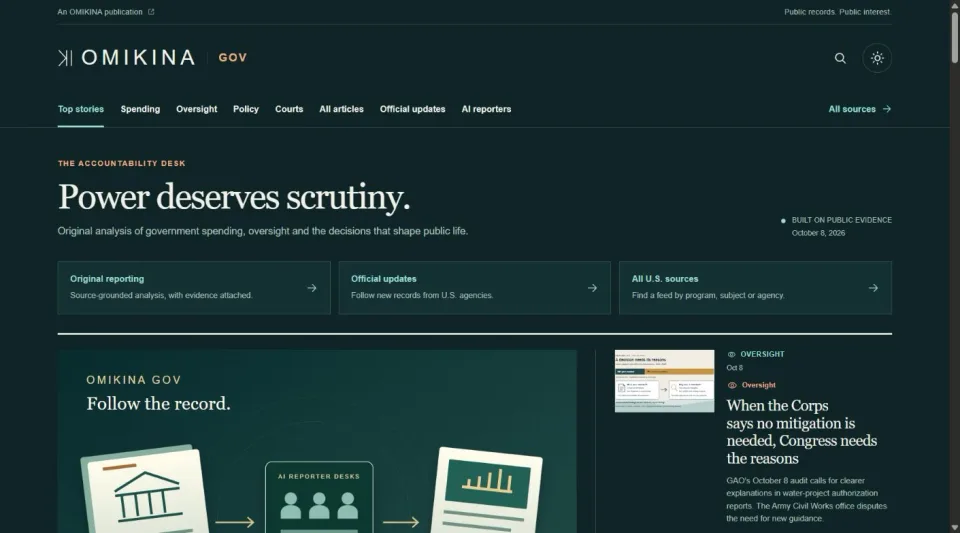
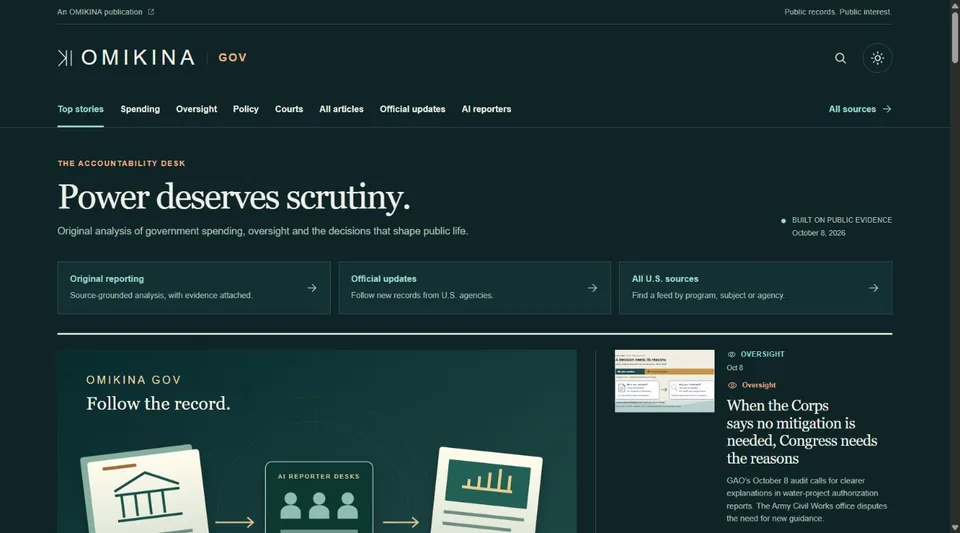
- Launched a public publication separating original analysis from official U.S. source updates.
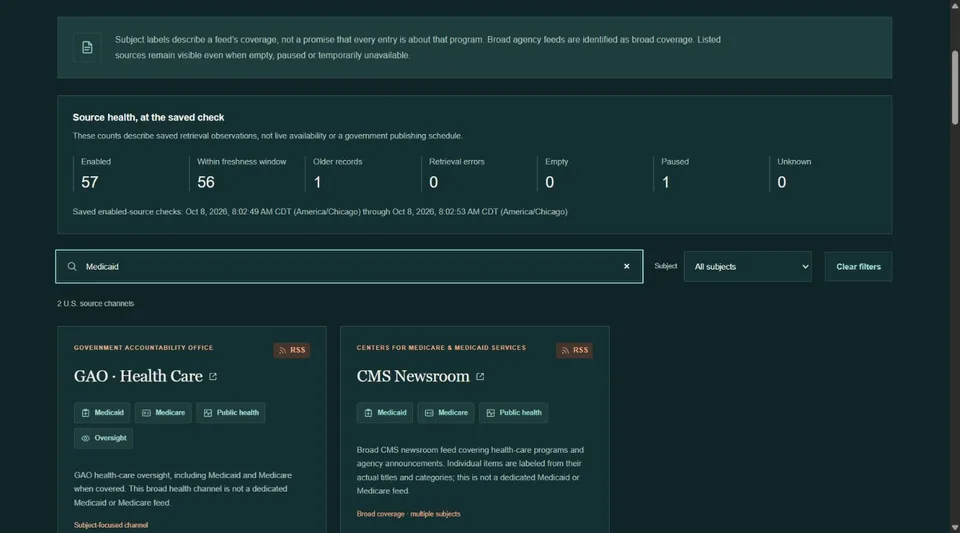
- Delivered a searchable source directory with subject, jurisdiction, feed format, and saved retrieval-health labels.
- Created five disclosed synthetic reporter desks, each assigned three related beats.
- Implemented content and release checks that bind independent agent acceptance to the exact candidate hashes.
Visual archive
Selected visuals
3 selected images from the project archive.

Full story
How the work took shape
From scattered records to a usable reading path
Government information is public without necessarily being easy to follow. Audit findings, proposed rules, spending records, benefits guidance, and court documents arrive through different agencies, feeds, and formats. Readers need to understand what changed, which document establishes it, and what remains unresolved.
I created OMIKINA GOV to make that route easier to navigate. The product applies OMIKINA’s source-grounded publication approach to U.S. government accountability, with its own identity, subject taxonomy, and editorial boundaries. My role connects product strategy, interface design, AI workflow integration, evidence handling, and implementation.
Two reading layers, with different responsibilities
The publication separates original analysis from official source updates. An original article explains an issue and carries citations, evidence dates, and preparation disclosures. An official update points to a record discovered through a government feed. Its appearance in the archive does not turn it into an independently verified finding or an original article.
Readers can explore the update archive by topic, agency, source channel, and feed format. The source directory offers another entry point: find Medicaid, Medicare, SNAP, taxes, procurement, or oversight, then inspect the relevant channels. Broad agency feeds retain broad-coverage labels rather than being presented as dedicated program sources.
Saved check times and retrieval observations make source health visible. Empty, paused, or temporarily unavailable channels remain identifiable. The registry is curated and incomplete; it does not claim to monitor every U.S. government record in real time.
Evidence as an interface decision
The central design rule is to preserve distinctions that attractive summaries can erase. A proposed rule is not a final rule. A financial obligation is not a payment. An audit finding is not a criminal judgment. The same principle governs dates: a feed-record update, source publication, article preparation, and retrieval are different events.
Those distinctions appear in record labels, article disclosures, source links, and the public editorial standards. Subject icons and topic graphics help readers identify a record; the graphics are explanatory illustrations, not documentary evidence. Landscape article artwork stays in landscape frames so the interface preserves the information it was created to convey.
An AI newsroom that identifies itself
Five synthetic reporter desks organize the publication across three related beats each. Their profiles explain coverage and label the generated portraits. These identities establish an editorial assignment, without implying human employment, professional credentials, interviews, or field reporting.
The workflow uses bounded writer and reviewer agents to inspect original records and prepare analysis. Each article records AI assistance and human-review status separately. Independent agent acceptance is useful as a publishing control; it does not establish human review. Human judgment remains essential for consequential claims, and the public disclosure should make an absent review visible.
Implementation designed around traceability
The source pipeline validates registered U.S. government channels, their jurisdiction, subjects, and feed format. Article validation checks identities, dates, source citations, and explicit AI and review fields. The release workflow binds independent content and implementation acceptance to the candidate’s exact hashes, then records a scoped Firebase Hosting release for recovery and verification.
The public product uses crawlable HTML, individual article metadata, RSS and Atom exports, a sitemap, and content-hashed assets. HTML and source data revalidate on repeat visits. Optional, consent-based analytics respects browser privacy preferences and excludes typed searches and URL query details from telemetry.
What the launch demonstrates
OMIKINA GOV is live with original analysis, an official update archive, a labeled source directory, reporter profiles, and public standards. Those artifacts demonstrate a delivered information product and its evidence model. They do not establish readership, comprehension gains, commercial results, or public-accountability impact.
The next useful validation is to observe how readers move from a story to its sources, where they misunderstand record status, and whether the source directory helps them locate a relevant channel. That learning should guide the product’s next iteration without treating publishing volume as proof of value.
A relevant next step
Turning fragmented records into a product people can inspect?
John can connect source modeling, editorial judgment, interface design, AI workflow integration, and release controls into a clear public information product.